Consumer & Research
A better way to browse coffee | Trade Coffee
Sole Designer · E-commerce & Subscription · Trade Coffee
Sole Designer · E-commerce & Subscription · Trade Coffee
Overview
Trade Coffee matches customers with 400+ roasters through a subscription model — but the browse experience was failing new users before they ever got to subscribe. As the sole designer, I redesigned the path to subscription and introduced a concept that shipped after I left: curated coffee collections, born directly from what customers told us they needed.
Overview
Trade Coffee matches customers with 400+ roasters through a subscription model — but the browse experience was failing new users before they ever got to subscribe. As the sole designer, I redesigned the path to subscription and introduced a concept that shipped after I left: curated coffee collections, born directly from what customers told us they needed.
The Problem
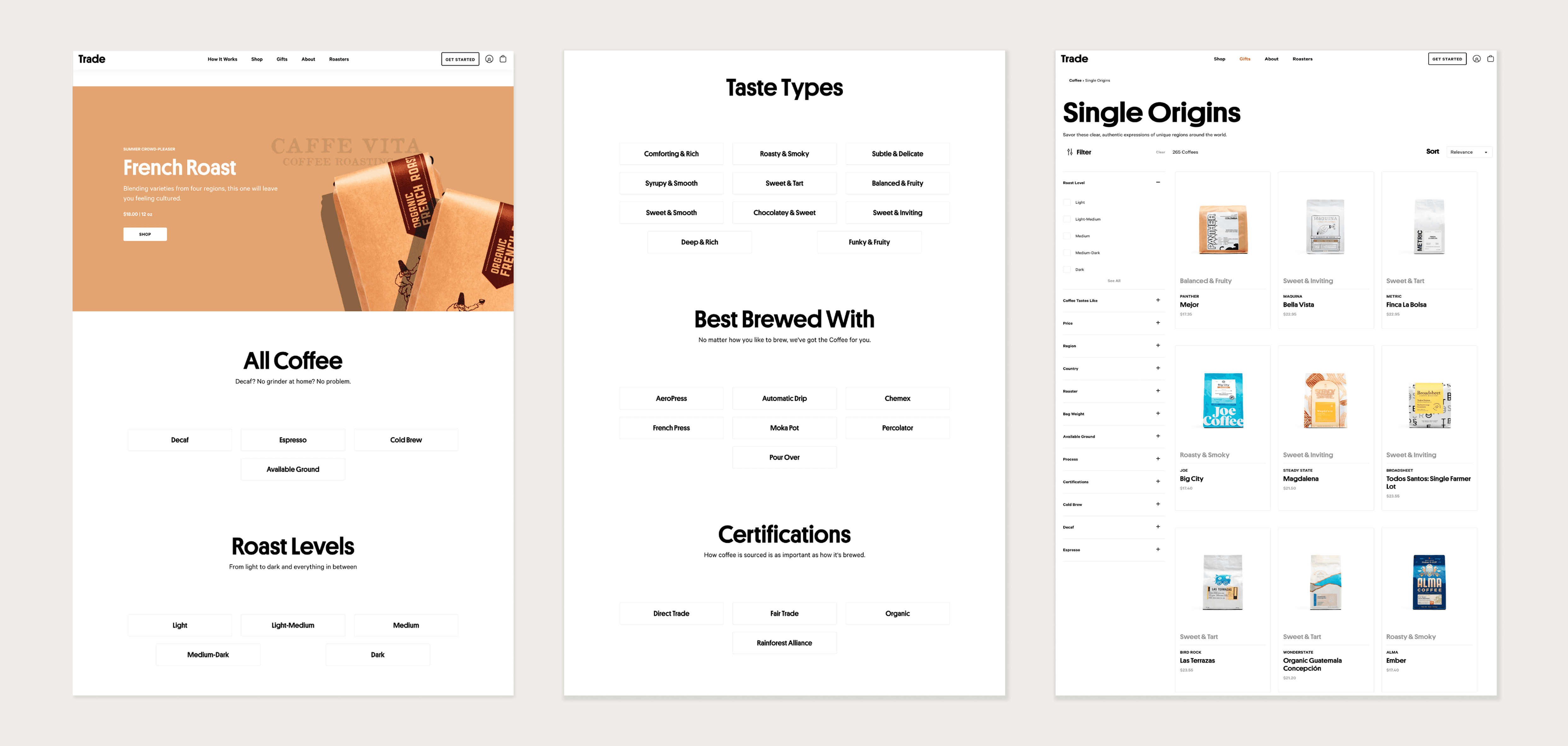
More than 70% of new users landed on product detail pages — but the design didn't explain the subscription benefit, and the browse experience was too intimidating for an average coffee drinker to navigate confidently.
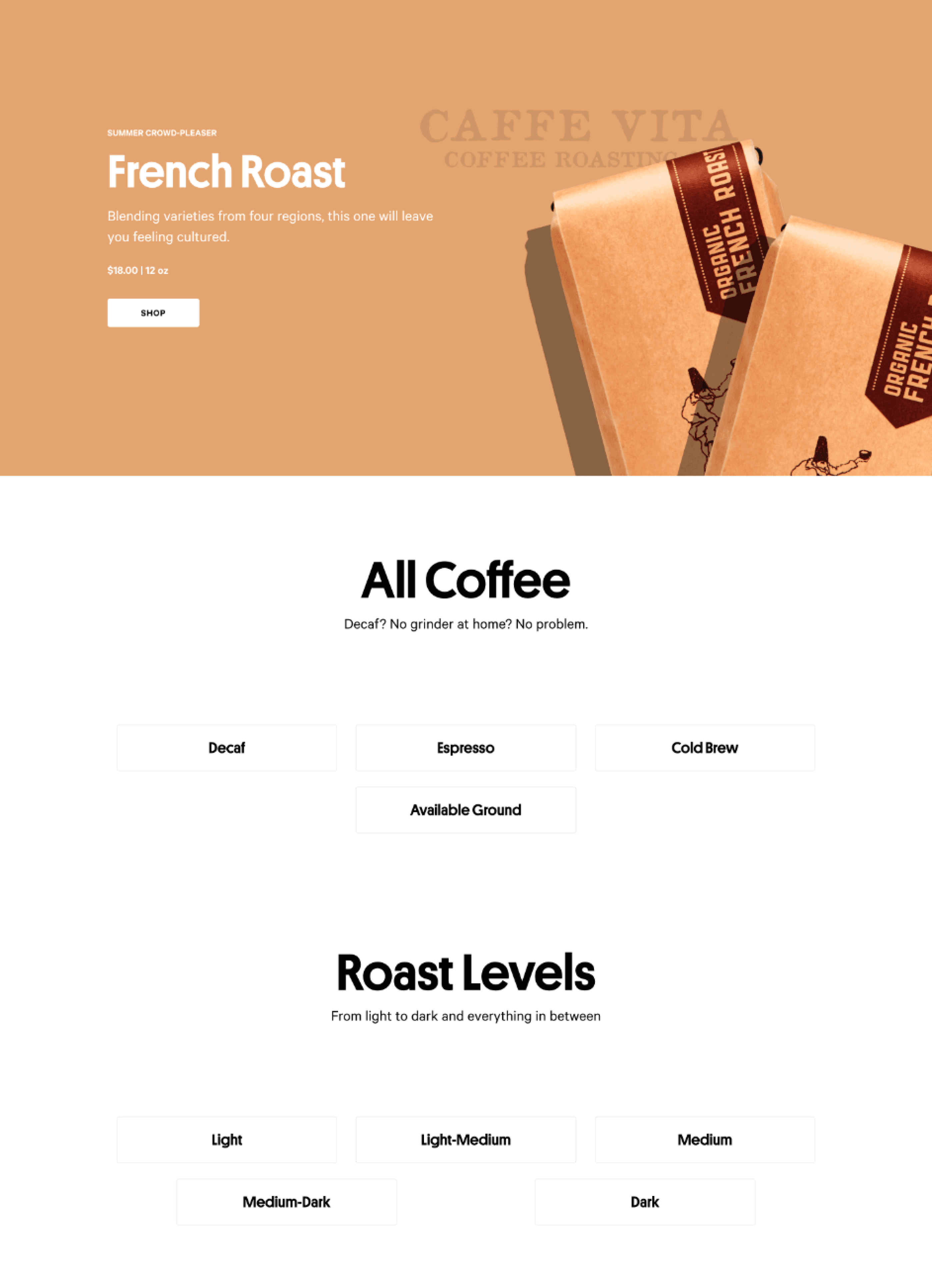
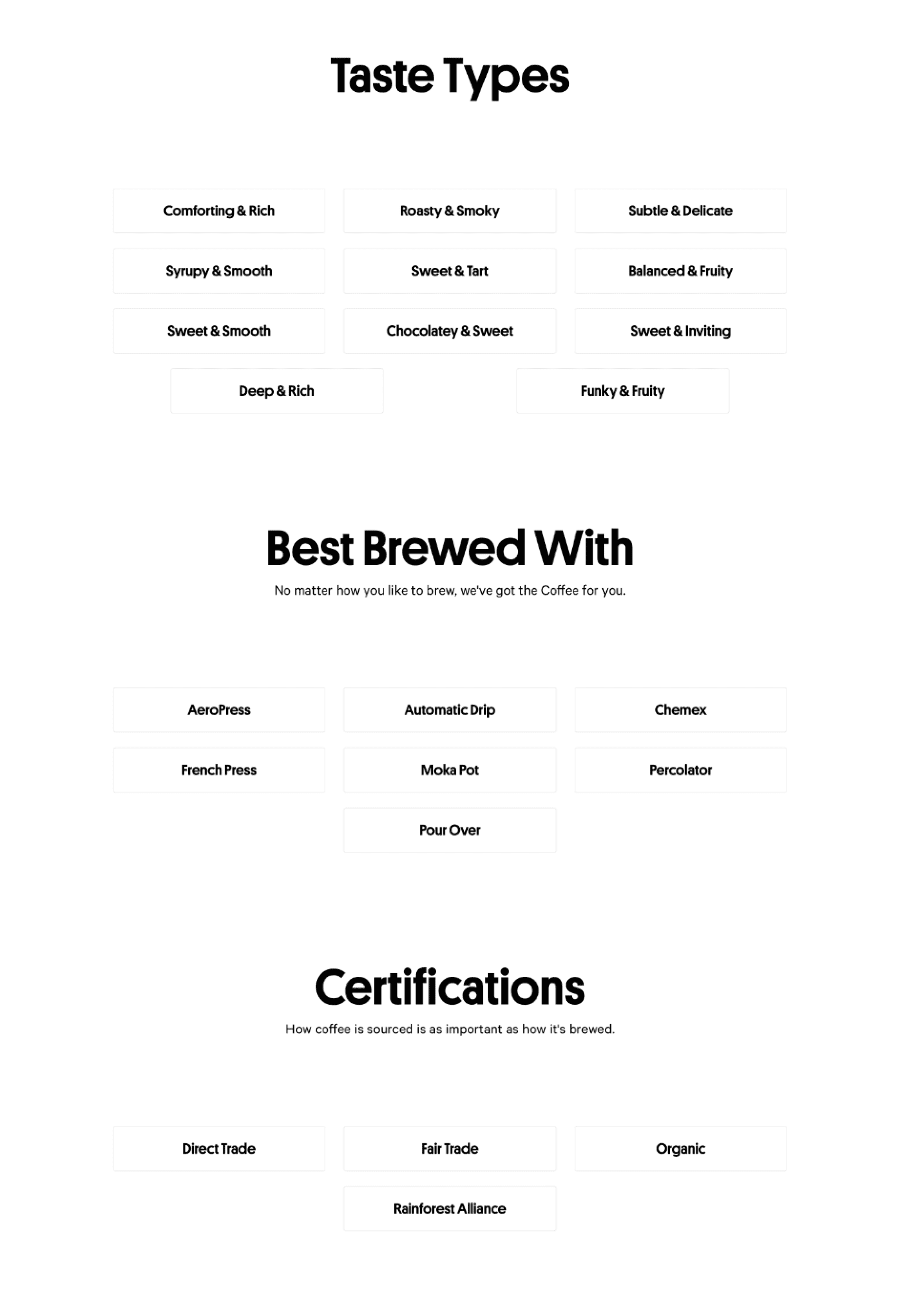
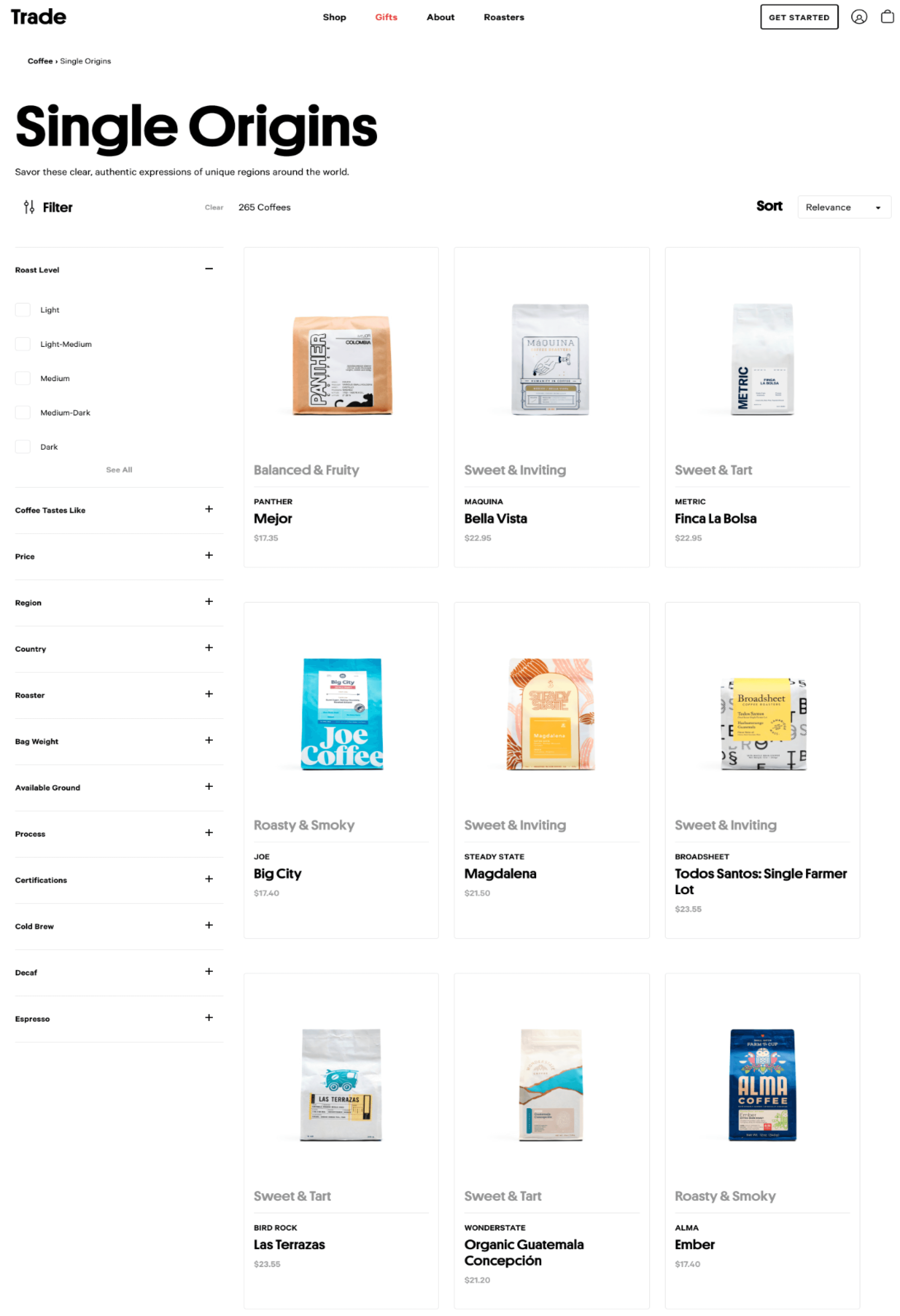
Two things were broken. The browse page was a wall of text links with no visual hierarchy, filter jargon most coffee drinkers don't understand, and mobile cards too tall to scan. And the perks, flexibility, and risk-free nature of the subscription weren't communicated at the moments new users needed them most.
The Problem
More than 70% of new users landed on product detail pages — but the design didn't explain the subscription benefit, and the browse experience was too intimidating for an average coffee drinker to navigate confidently.
Two things were broken. The browse page was a wall of text links with no visual hierarchy, filter jargon most coffee drinkers don't understand, and mobile cards too tall to scan. And the perks, flexibility, and risk-free nature of the subscription weren't communicated at the moments new users needed them most.
Approach
I grounded the work in four research inputs before designing anything:
Customer surveys revealed the same thing repeatedly — the selection was overwhelming and customers wanted Trade to just pick for them
The CX team confirmed it: first-time users consistently struggled to browse
Baymard Institute best practices informed every page
Competitive research across subscription categories showed what builds trust and drives first-time conversion
User tests ran iteratively throughout — from UI elements to subscription messaging — to validate before committing.
Approach
I grounded the work in four research inputs before designing anything:
Customer surveys revealed the same thing repeatedly — the selection was overwhelming and customers wanted Trade to just pick for them
The CX team confirmed it: first-time users consistently struggled to browse
Baymard Institute best practices informed every page
Competitive research across subscription categories showed what builds trust and drives first-time conversion
User tests ran iteratively throughout — from UI elements to subscription messaging — to validate before committing.

Three directions, one shipped
Browse and subscribe with curated collections — shipped 2022, expanded 2026
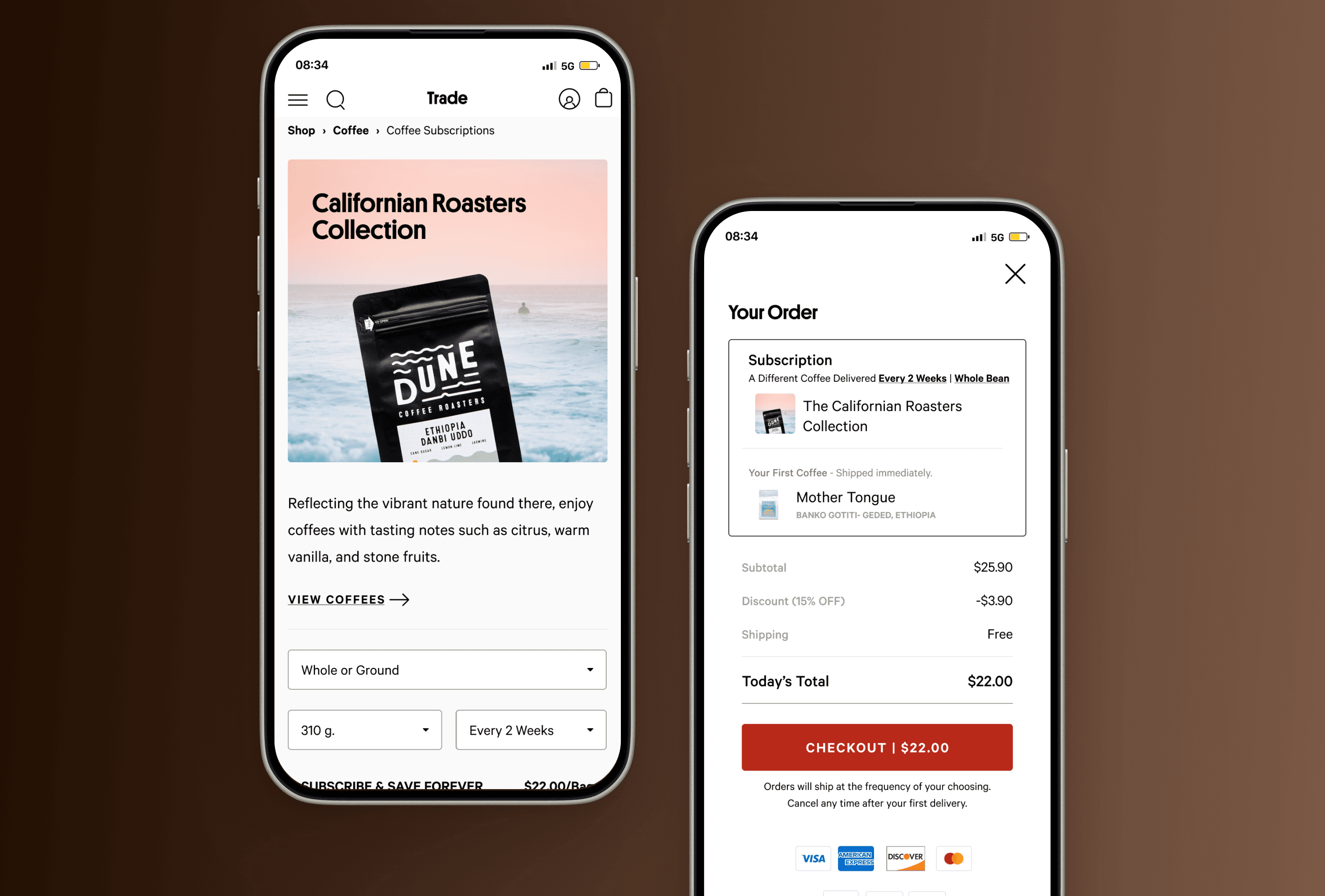
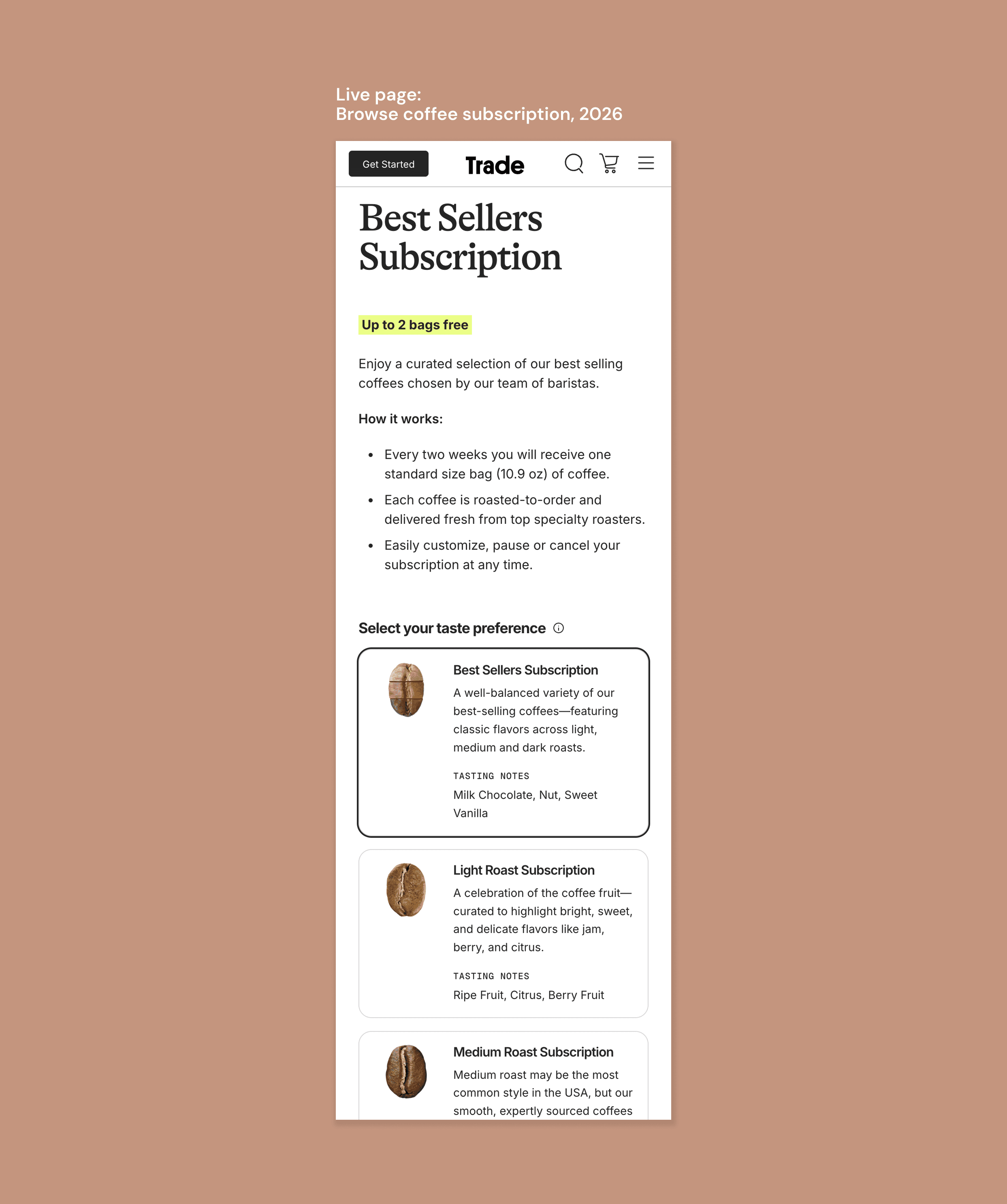
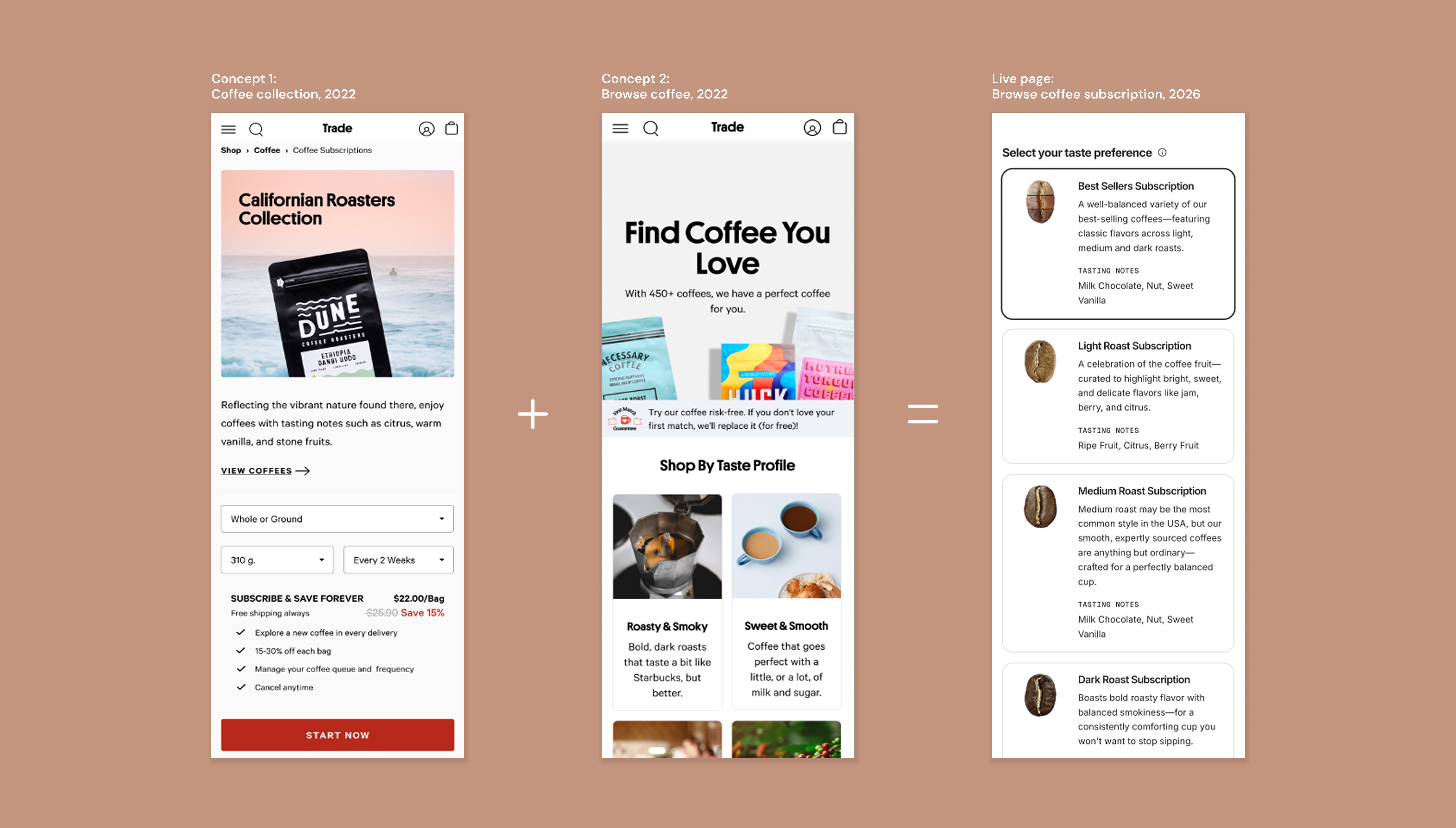
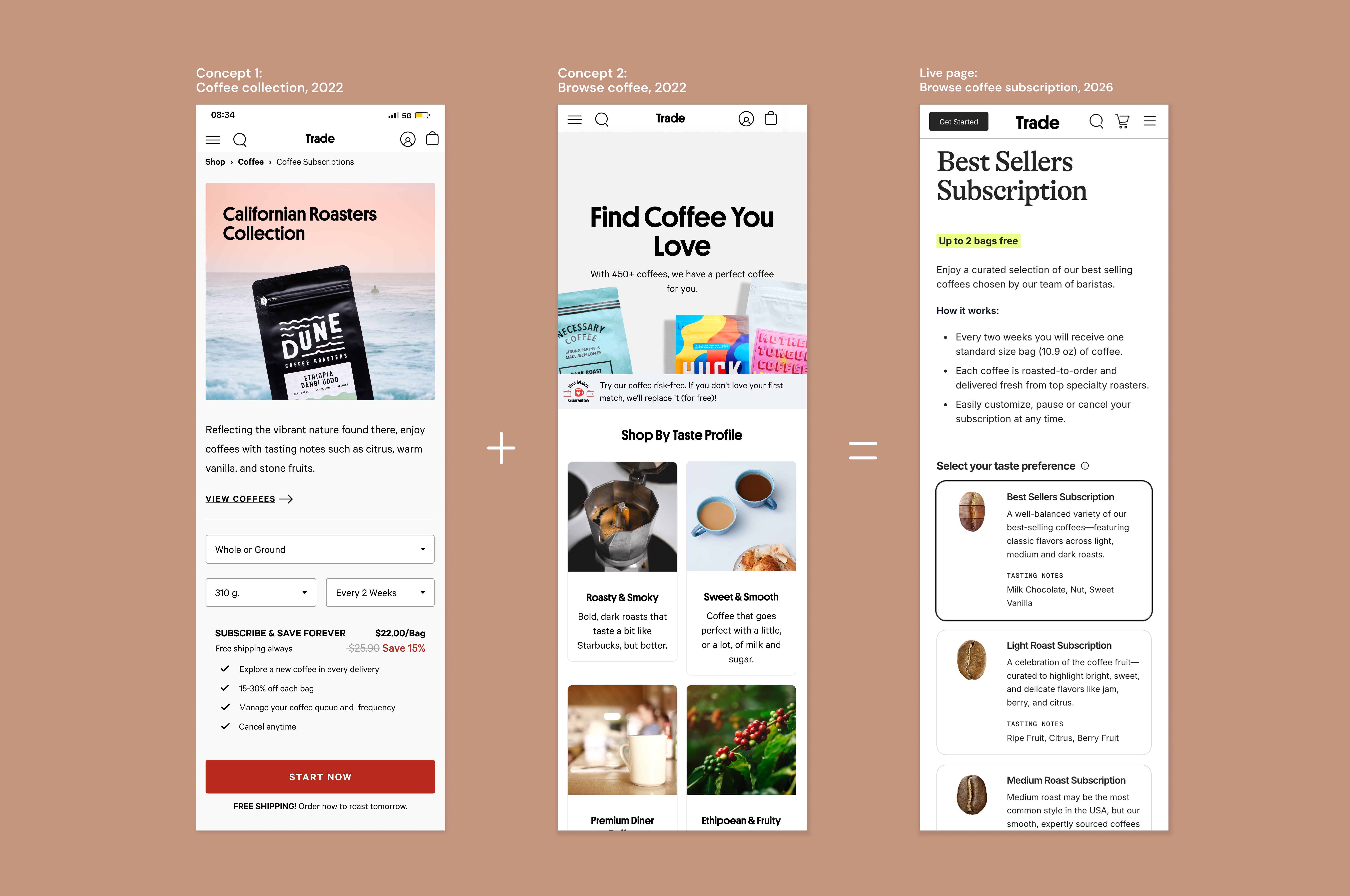
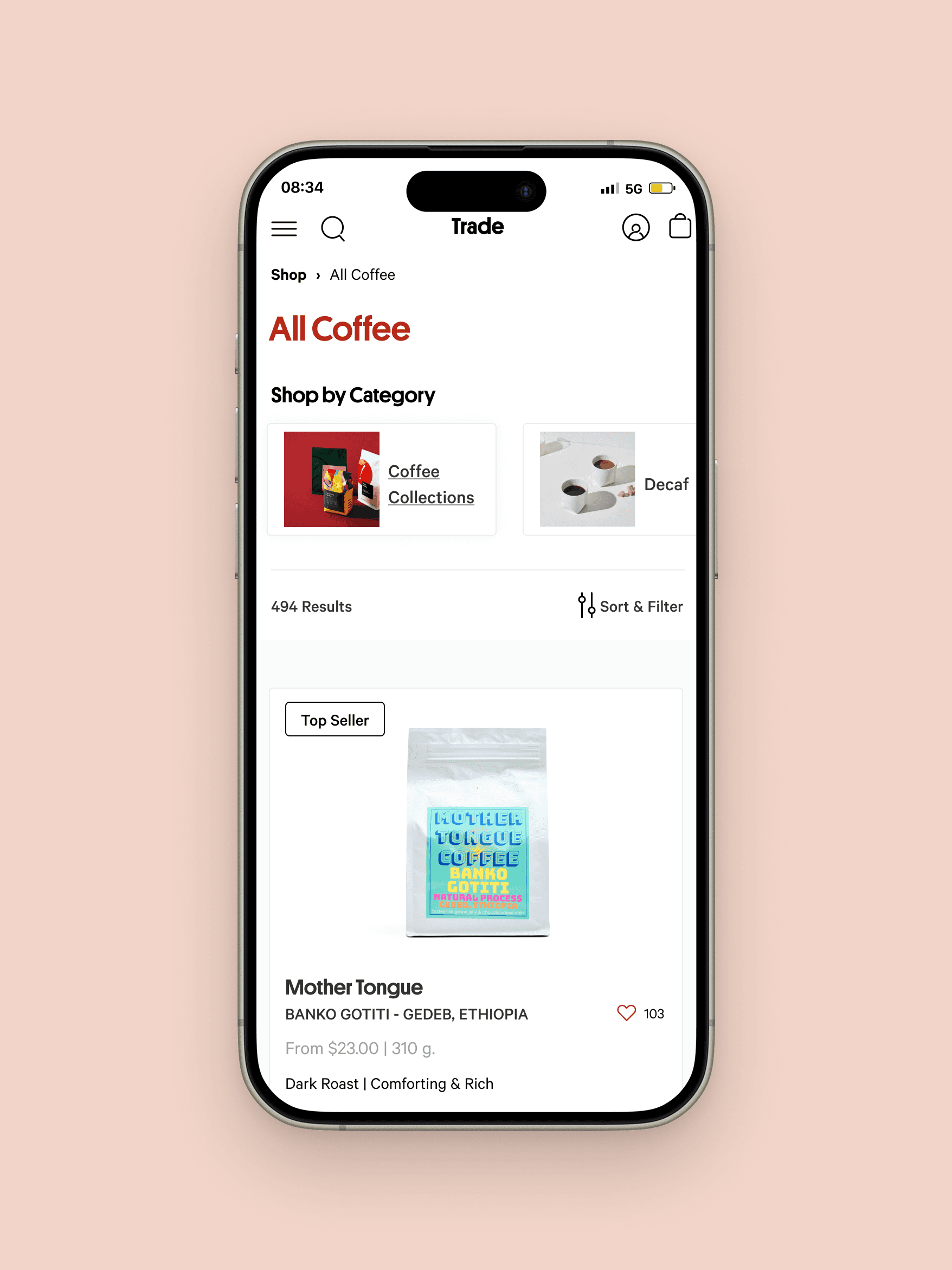
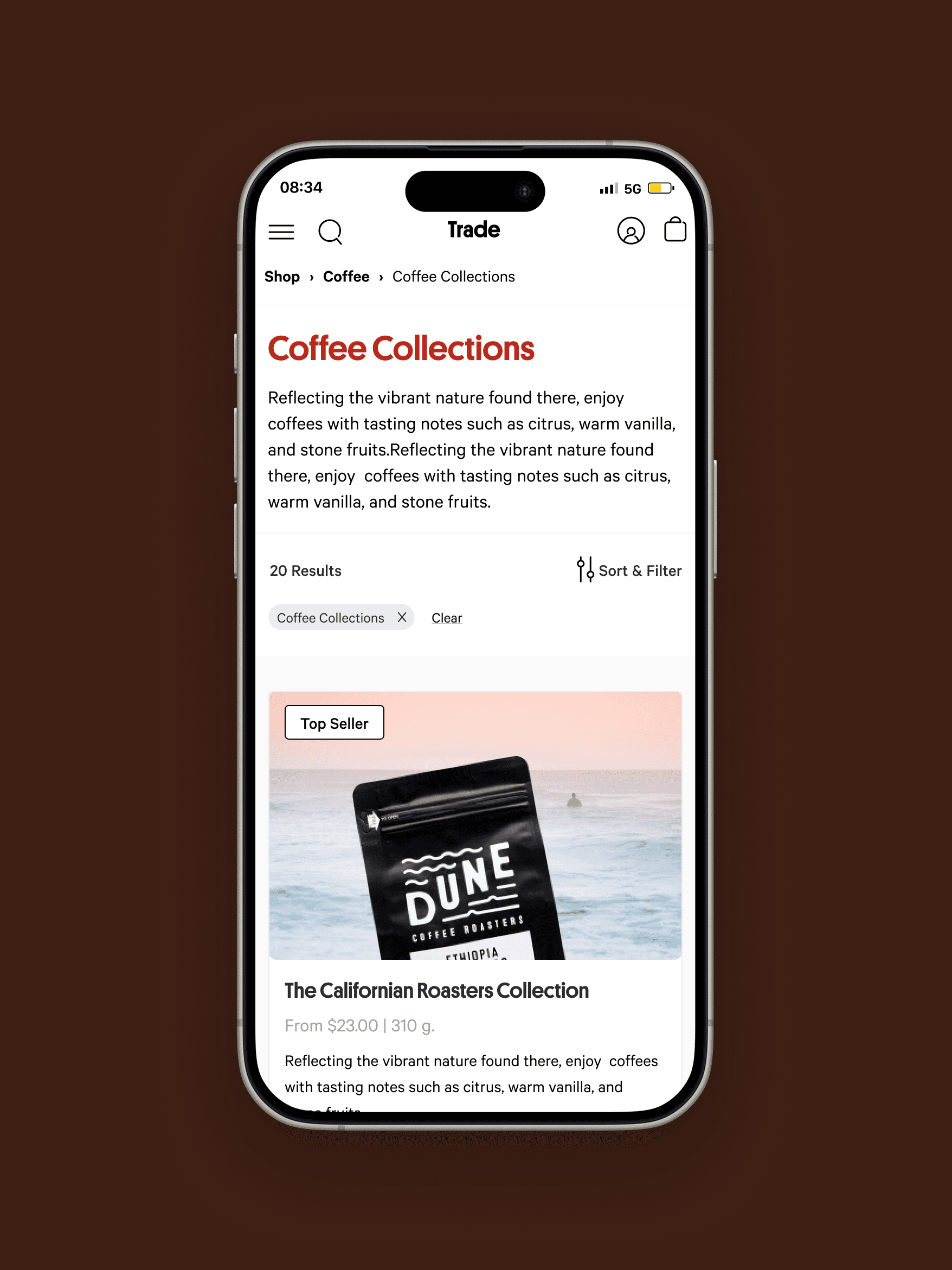
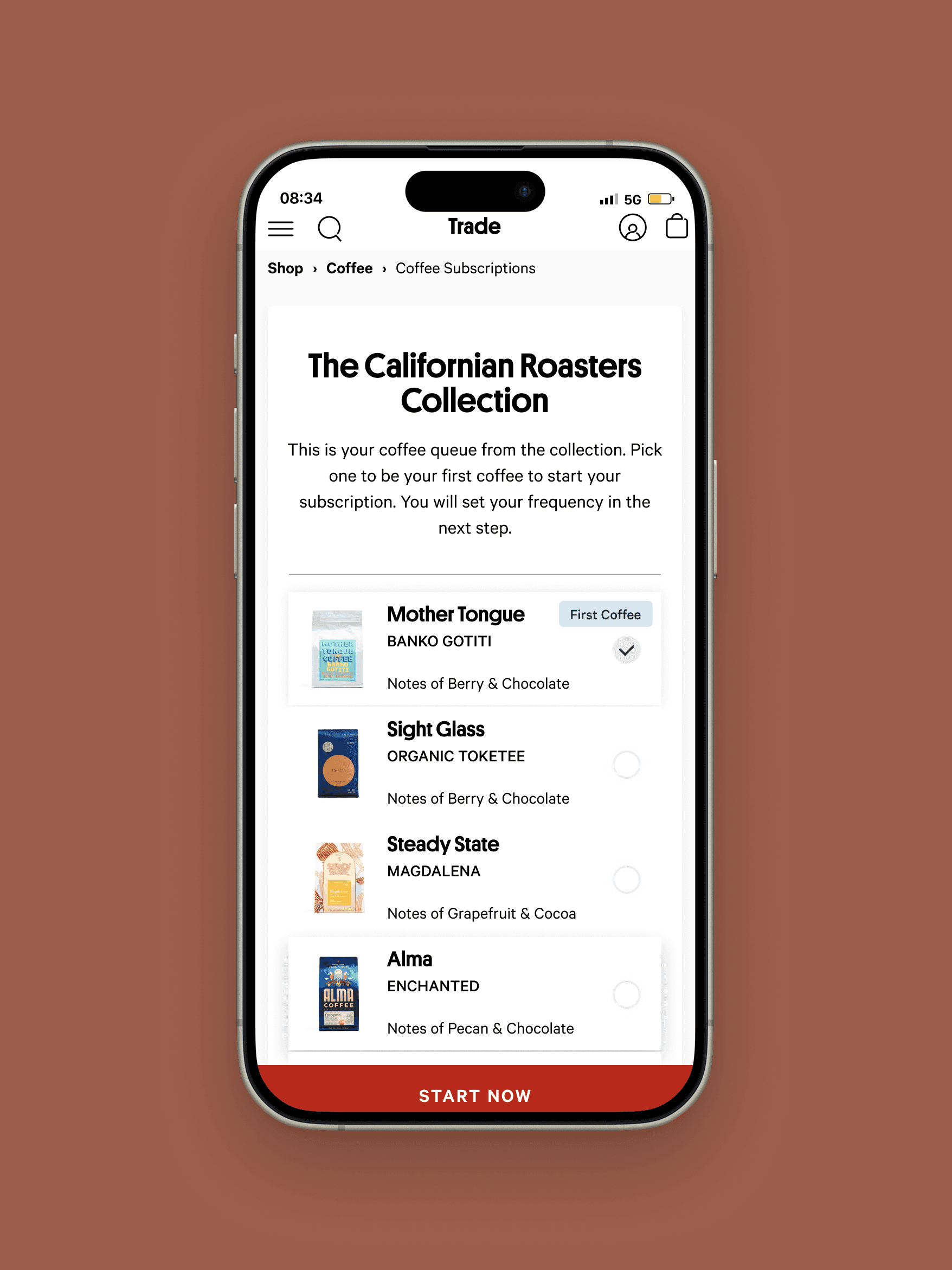
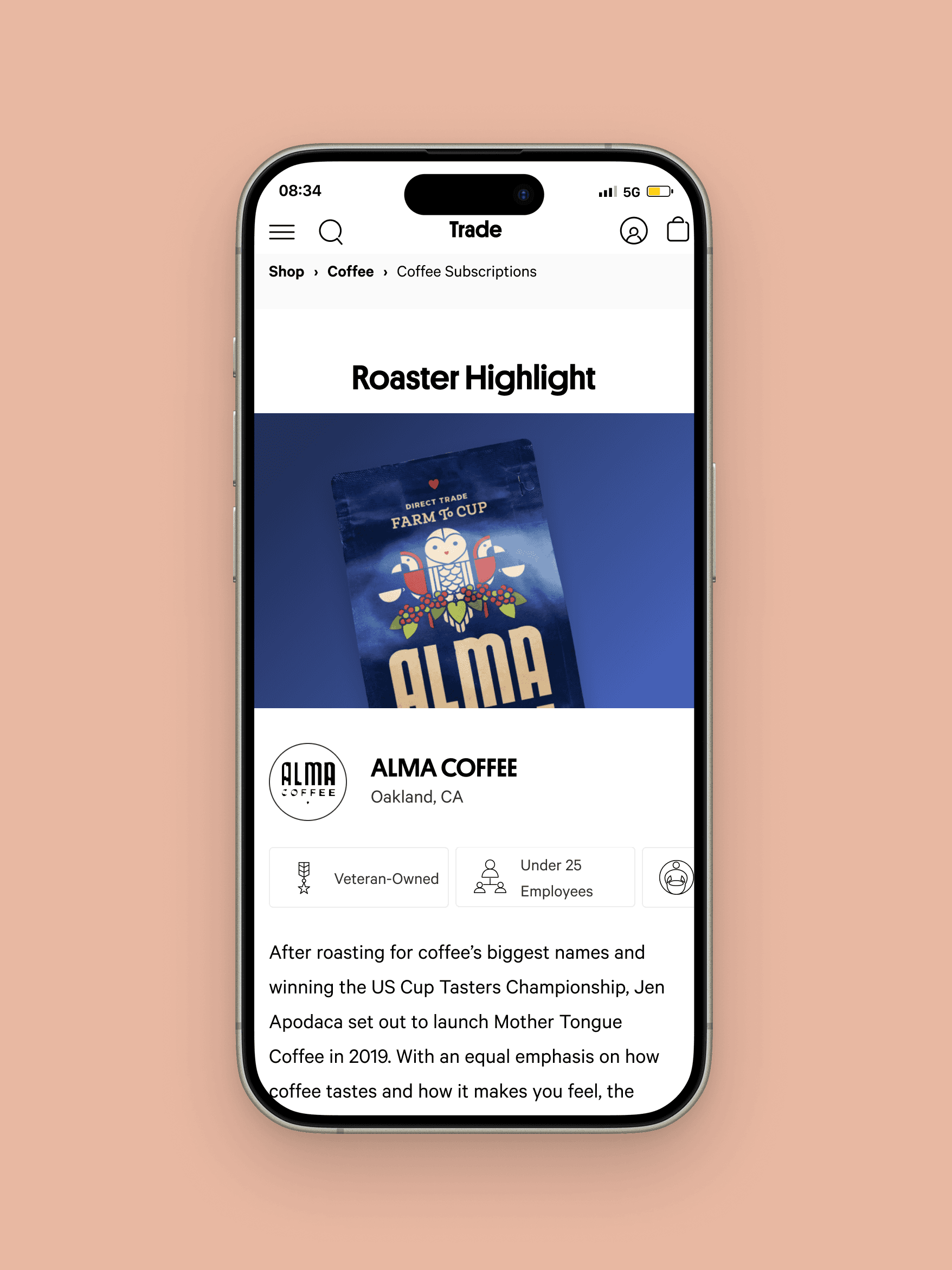
A dedicated landing page with accessible tools to help users find coffee quickly — without the quiz or filter jargon. The page combines browsable subscription entry points with curated taste-profile collections (like “Best Sellers,” “Light Roast,” and “Medium Roast”), directly addressing survey feedback that customers wanted Trade to pick for them. When I checked the live product in April 2026, both concepts had shipped and merged into a single unified experience.
Three directions, one shipped
Browse and subscribe with curated collections — shipped 2022, expanded 2026
The collection concept wasn't a creative leap — it was a direct translation of what customers said. Survey after survey told us the same thing: the selection was too big, and customers wanted to be guided.
I explored three concepts. Two of them made it in.
What this shows
Consumer e-commerce thinking, end-to-end ownership as the sole designer, and the ability to translate customer research directly into product concepts. The coffee collection model — research-driven, feasibility-aware, and eventually shipped — including a browsing model that made it into the product years after I'd left.
The best validation isn't a metric. Sometimes it's seeing your idea ship after you've already left the building.
What this shows
Consumer e-commerce thinking, end-to-end ownership as the sole designer, and the ability to translate customer research directly into product concepts. The coffee collection model — research-driven, feasibility-aware, and eventually shipped — including a browsing model that made it into the product years after I'd left.
The best validation isn't a metric. Sometimes it's seeing your idea ship after you've already left the building.
Consumer & Research
A better way to browse coffee | Trade Coffee
Sole Designer · E-commerce & Subscription · Trade Coffee
Sole Designer · E-commerce & Subscription · Trade Coffee
Overview
Trade Coffee matches customers with 400+ roasters through a subscription model — but the browse experience was failing new users before they ever got to subscribe. As the sole designer, I redesigned the path to subscription and introduced a concept that shipped after I left: curated coffee collections, born directly from what customers told us they needed.
Overview
Trade Coffee matches customers with 400+ roasters through a subscription model — but the browse experience was failing new users before they ever got to subscribe. As the sole designer, I redesigned the path to subscription and introduced a concept that shipped after I left: curated coffee collections, born directly from what customers told us they needed.
The Problem
More than 70% of new users landed on product detail pages — but the design didn't explain the subscription benefit, and the browse experience was too intimidating for an average coffee drinker to navigate confidently.
Two things were broken. The browse page was a wall of text links with no visual hierarchy, filter jargon most coffee drinkers don't understand, and mobile cards too tall to scan. And the perks, flexibility, and risk-free nature of the subscription weren't communicated at the moments new users needed them most.
The Problem
More than 70% of new users landed on product detail pages — but the design didn't explain the subscription benefit, and the browse experience was too intimidating for an average coffee drinker to navigate confidently.
Two things were broken. The browse page was a wall of text links with no visual hierarchy, filter jargon most coffee drinkers don't understand, and mobile cards too tall to scan. And the perks, flexibility, and risk-free nature of the subscription weren't communicated at the moments new users needed them most.
Approach
I grounded the work in four research inputs before designing anything:
Customer surveys revealed the same thing repeatedly — the selection was overwhelming and customers wanted Trade to just pick for them
The CX team confirmed it: first-time users consistently struggled to browse
Baymard Institute best practices informed every page
Competitive research across subscription categories showed what builds trust and drives first-time conversion
User tests ran iteratively throughout — from UI elements to subscription messaging — to validate before committing.
Approach
I grounded the work in four research inputs before designing anything:
Customer surveys revealed the same thing repeatedly — the selection was overwhelming and customers wanted Trade to just pick for them
The CX team confirmed it: first-time users consistently struggled to browse
Baymard Institute best practices informed every page
Competitive research across subscription categories showed what builds trust and drives first-time conversion
User tests ran iteratively throughout — from UI elements to subscription messaging — to validate before committing.
Three directions, one shipped
Browse and subscribe with curated collections — shipped 2022, expanded 2026
A dedicated landing page with accessible tools to help users find coffee quickly — without the quiz or filter jargon. The page combines browsable subscription entry points with curated taste-profile collections (like “Best Sellers,” “Light Roast,” and “Medium Roast”), directly addressing survey feedback that customers wanted Trade to pick for them. When I checked the live product in April 2026, both concepts had shipped and merged into a single unified experience.
Three directions, one shipped
Browse and subscribe with curated collections — shipped 2022, expanded 2026
The collection concept wasn't a creative leap — it was a direct translation of what customers said. Survey after survey told us the same thing: the selection was too big, and customers wanted to be guided.
I explored three concepts. Two of them made it in.
What this shows
Consumer e-commerce thinking, end-to-end ownership as the sole designer, and the ability to translate customer research directly into product concepts. The coffee collection model — research-driven, feasibility-aware, and eventually shipped — including a browsing model that made it into the product years after I'd left.
The best validation isn't a metric. Sometimes it's seeing your idea ship after you've already left the building.
What this shows
Consumer e-commerce thinking, end-to-end ownership as the sole designer, and the ability to translate customer research directly into product concepts. The coffee collection model — research-driven, feasibility-aware, and eventually shipped — including a browsing model that made it into the product years after I'd left.
The best validation isn't a metric. Sometimes it's seeing your idea ship after you've already left the building.
Consumer & Research
A better way to browse coffee | Trade Coffee
Sole Designer · E-commerce & Subscription · Trade Coffee
Sole Designer · E-commerce & Subscription · Trade Coffee
Overview
Trade Coffee matches customers with 400+ roasters through a subscription model — but the browse experience was failing new users before they ever got to subscribe. As the sole designer, I redesigned the path to subscription and introduced a concept that shipped after I left: curated coffee collections, born directly from what customers told us they needed.
Overview
Trade Coffee matches customers with 400+ roasters through a subscription model — but the browse experience was failing new users before they ever got to subscribe. As the sole designer, I redesigned the path to subscription and introduced a concept that shipped after I left: curated coffee collections, born directly from what customers told us they needed.
The Problem
More than 70% of new users landed on product detail pages — but the design didn't explain the subscription benefit, and the browse experience was too intimidating for an average coffee drinker to navigate confidently.
Two things were broken. The browse page was a wall of text links with no visual hierarchy, filter jargon most coffee drinkers don't understand, and mobile cards too tall to scan. And the perks, flexibility, and risk-free nature of the subscription weren't communicated at the moments new users needed them most.
The Problem
More than 70% of new users landed on product detail pages — but the design didn't explain the subscription benefit, and the browse experience was too intimidating for an average coffee drinker to navigate confidently.
Two things were broken. The browse page was a wall of text links with no visual hierarchy, filter jargon most coffee drinkers don't understand, and mobile cards too tall to scan. And the perks, flexibility, and risk-free nature of the subscription weren't communicated at the moments new users needed them most.
Approach
I grounded the work in four research inputs before designing anything:
Customer surveys revealed the same thing repeatedly — the selection was overwhelming and customers wanted Trade to just pick for them
The CX team confirmed it: first-time users consistently struggled to browse
Baymard Institute best practices informed every page
Competitive research across subscription categories showed what builds trust and drives first-time conversion
User tests ran iteratively throughout — from UI elements to subscription messaging — to validate before committing.
Approach
I grounded the work in four research inputs before designing anything:
Customer surveys revealed the same thing repeatedly — the selection was overwhelming and customers wanted Trade to just pick for them
The CX team confirmed it: first-time users consistently struggled to browse
Baymard Institute best practices informed every page
Competitive research across subscription categories showed what builds trust and drives first-time conversion
User tests ran iteratively throughout — from UI elements to subscription messaging — to validate before committing.
Three directions, one shipped
Browse and subscribe with curated collections — shipped 2022, expanded 2026
A dedicated landing page with accessible tools to help users find coffee quickly — without the quiz or filter jargon. The page combines browsable subscription entry points with curated taste-profile collections (like “Best Sellers,” “Light Roast,” and “Medium Roast”), directly addressing survey feedback that customers wanted Trade to pick for them. When I checked the live product in April 2026, both concepts had shipped and merged into a single unified experience.
Three directions, one shipped
Browse and subscribe with curated collections — shipped 2022, expanded 2026
The collection concept wasn't a creative leap — it was a direct translation of what customers said. Survey after survey told us the same thing: the selection was too big, and customers wanted to be guided.
I explored three concepts. Two of them made it in.
What this shows
Consumer e-commerce thinking, end-to-end ownership as the sole designer, and the ability to translate customer research directly into product concepts. The coffee collection model — research-driven, feasibility-aware, and eventually shipped — including a browsing model that made it into the product years after I'd left.
The best validation isn't a metric. Sometimes it's seeing your idea ship after you've already left the building.
What this shows
Consumer e-commerce thinking, end-to-end ownership as the sole designer, and the ability to translate customer research directly into product concepts. The coffee collection model — research-driven, feasibility-aware, and eventually shipped — including a browsing model that made it into the product years after I'd left.
The best validation isn't a metric. Sometimes it's seeing your idea ship after you've already left the building.